
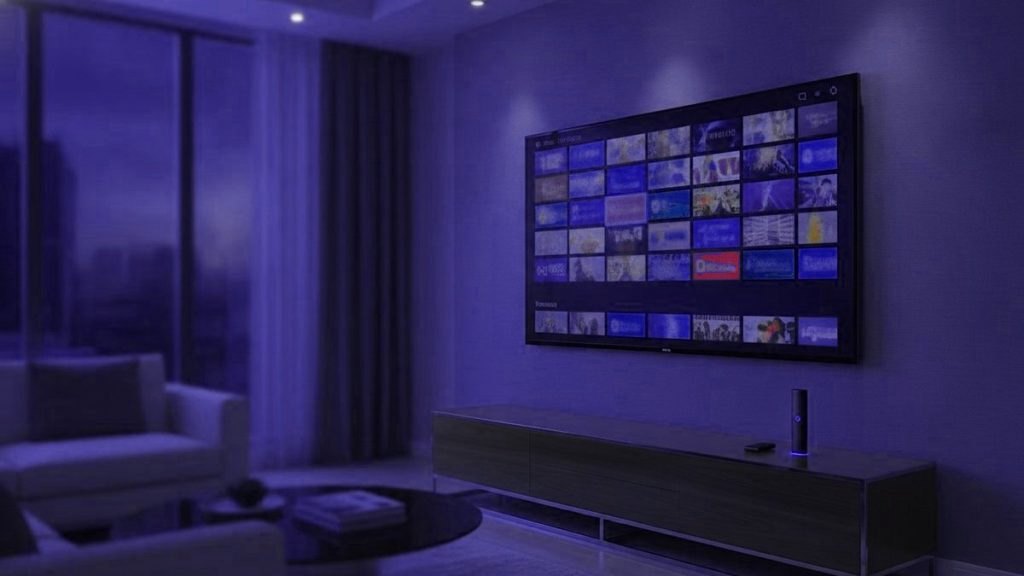
If your television comes through a broadband box from Orange or Free in France, from Deutsche Telekom in Germany, from Movistar in Spain, or through a Sky Stream puck in Britain, you have been watching IPTV for years without calling it that. Internet Protocol Television simply means that pictures and sound travel as data packets rather than as a signal from an aerial, a dish or a coaxial cable. So the useful question for a European household is rarely “what is IPTV?” It is “which kind of IPTV am I looking at?” There are two, they behave quite differently, and most of the confusion online comes from blurring them together.
Two things called IPTV in Europe
Operator IPTV: the box that arrived with your broadband
Across much of the continent, telecoms companies sell television as part of a bundle. France built its entire pay-TV market this way: the router supplied by the operator doubles as a TV decoder, and channels arrive down the same DSL or fibre line as the internet. Telekom’s MagentaTV, Movistar Plus+ in Spain, Proximus in Belgium and KPN in the Netherlands follow similar models. In the UK, Sky now delivers its Stream and Glass products over broadband instead of a dish.
What makes this operator IPTV is that the company owns or controls the network between its servers and your living room. Television traffic can be given priority inside that network, channels are often sent once to many homes in the same area rather than individually to each one, and the set-top box is locked to the operator. It only works on that operator’s line, the contract usually runs for twelve or twenty-four months, and the channel line-up is whatever the operator has licensed for your country.
Independent IPTV: a login that crosses the open internet
The second kind is a subscription from a provider that is not your broadband company. You receive login details, put them into a player app on a device you already own, and channels arrive over the ordinary public internet, through whichever broadband company you happen to use. Nothing is prioritised along the way. Your stream shares the road with video calls, game downloads and everyone else’s Netflix.
That is what Euroskara sells, and it is what most people mean when they search the term today. The appeal for households in Europe is fairly consistent: channels from several countries in one place, a subscription that is not tied to a line or an address, and short terms without a two-year contract. The trade-off is that the quality of your evening depends on more links in the chain, some of which nobody controls end to end.
Side by side
| Operator IPTV | Independent IPTV | |
|---|---|---|
| Who carries the stream | Your broadband company, on its own network | The public internet, via any broadband company |
| Equipment | A decoder supplied by the operator, usually rented | Your smart TV, a stick, a phone or a box you choose |
| Where it works | At the address on the contract | Anywhere with a decent connection |
| Channel range | One country’s licensed line-up, plus paid add-ons | Many countries in one list |
| Commitment | Commonly 12 to 24 months, bundled with broadband | From one month, no bundle |
| Picture during peak hours | Protected by traffic priority on the operator’s network | Depends on your line, your router and the provider’s servers |
Neither column is simply better. Someone who watches one country’s channels on one television and values a guaranteed picture above everything may be well served by the operator bundle. A household that follows football in two countries, keeps family news from a third and moves between a flat and a holiday home will find the second column fits their life more closely.
Following one channel from source to sofa
With independent IPTV, a channel passes through five stages before it plays.
- Capture. The provider receives the broadcast feed.
- Encoding. The feed is compressed, typically with H.264 for HD or HEVC (H.265) for 4K, and cut into short segments.
- Delivery servers. Those segments sit on servers that answer requests from subscribers. Their location and how many people they serve at once shape everything that follows.
- The route to your home. Data leaves the provider’s network, crosses exchange points and enters your broadband company’s network. Between London, Frankfurt, Amsterdam and Paris this journey is short; to the edge of the continent it takes a few more hops.
- Your player. The app on your device downloads a few seconds of video ahead of what is on screen and plays from that small reserve. When the reserve runs dry, you see the spinning wheel.
Most complaints about IPTV trace to stage three or to the final few metres of stage four: an overloaded server at kick-off, or Wi-Fi struggling to reach a TV at the far end of the house.
What your European connection can carry
Broadband across Europe is a patchwork, even within a single country. The figures below are working allowances per stream, not guarantees. Actual bitrate depends on the channel, the codec and how much motion is on screen; a football match needs more than a studio news programme.
| Stream | Allow per screen | Comment |
|---|---|---|
| SD | About 3 to 4 Mbps | A useful fallback when the line is struggling |
| HD / FHD | About 10 Mbps | What most viewers watch most of the time |
| 4K | About 25 Mbps | Wants a wired connection or strong Wi-Fi |
Full fibre
Fibre to the home, widespread in Spain, Portugal, France and the Nordic countries and spreading quickly in the UK and Ireland, has more capacity than any household will use for television. On fibre, the limiting factor is almost always Wi-Fi inside the home or the provider’s servers, not the line.
Cable
Cable broadband, such as Virgin Media in the UK and Ireland, Vodafone’s cable networks in Germany or Ziggo in the Netherlands, offers high download speeds. Because capacity is shared among homes on the same local segment, some cable users notice slower evenings in busy areas. It is worth running a speed test at 21:00 on a weekday rather than trusting the figure on your bill.
Copper lines: VDSL and ADSL
Fibre to the cabinet with VDSL on the last stretch of copper remains common in the UK, Germany, Italy and Ireland. Speed falls with distance from the street cabinet, so neighbours on the same package can see very different results. Two HD streams at once are normally comfortable on VDSL. Older ADSL lines, still found in rural areas, may manage one HD stream; setting the player to a lower-quality version of each channel keeps them watchable.
Mobile and satellite broadband
4G and 5G home routers can carry IPTV well, but check the data allowance. An HD stream uses several gigabytes an hour, so a capped plan disappears in a weekend of sport. Satellite broadband has improved sharply with low-orbit services, though bad weather and busy evenings still cause variation.
Three homes, three lines
These are illustrations to show how the pieces combine, not customer stories.
A flat in Lisbon on full fibre. Three people, three screens, one of them a 4K television in the living room. The line has capacity to spare, but the router sits in a hallway cupboard behind a concrete wall. A 4K picture that stutters in the evening while the HD stream in the kitchen plays perfectly points at Wi-Fi, not the service. A short Ethernet cable or a powerline adapter usually settles it.
A cottage in County Kerry on ADSL. One television, a line that tests at modest speeds on a good day. Here the right approach is choosing the HD or SD variant of each channel, wiring the TV device to the router, and avoiding 4K entirely. The service can be the same one the Lisbon flat uses; the experience is shaped by the line.
A terraced house in Leeds on VDSL. Two screens, a streaming stick behind the TV and a router at the front of the house. Evenings are fine until someone upstairs starts a large game download. Most routers let you give priority to a named device, which fixes this in about five minutes.
Where the evening slowdown really comes from
Every service looks good at eleven on a Tuesday morning. The honest test is a big European football night, when kick-offs cluster around 21:00 Central European Time and a very large number of people press play within the same minute. Three things can struggle at that moment. Your broadband company’s network is busier than usual. The provider’s servers suddenly have to serve a spike of viewers on the same few channels. And inside your home, several devices may compete for the same Wi-Fi.
You can control the last one completely and influence the first one by choosing a sensible time to test. The middle one is what separates providers from each other, and it is invisible from a sales page. That is why we offer a free 24-hour trial and suggest scheduling it around a match rather than a quiet afternoon.
Time zones and the programme guide
Europe spans three main time zones, and they matter more for IPTV than most people expect. The UK, Ireland and Portugal run on Greenwich Mean Time in winter and one hour ahead in summer. Most of the continent, from Spain to Poland, uses Central European Time. Greece, Finland, Romania, Bulgaria and the Baltic states are one hour further ahead again.
The electronic programme guide (EPG) lists what is showing on each channel. If a guide is published in one zone and your device thinks it is in another, every programme appears an hour early or late. The fix is almost always in the player: most apps, including TiViMate and IPTV Smarters Pro, let you shift the guide by whole hours. Check it once against a channel you know, such as the evening news in your own country, and it stays right.
The words you will meet
Xtream Codes login: a server address, a username and a password. Most players accept these three values and build the channel list for you. It is the simplest route, and our Xtream Codes guide walks through it.
M3U playlist: a single long web address that contains the same details. Players such as VLC and Kodi prefer it. Anyone who has the link has your account, so keep it private. See the M3U guide.
Portal or MAC login: used by MAG boxes and some Formuler models. The provider links your subscription to the device’s hardware address rather than issuing a password. The MAG and Formuler guide covers it.
Catch-up: the ability to go back and watch programmes that aired in the past few days on channels that support it, in players that support it.
What independent IPTV will not do
It does not replace your broadband; you still need an internet connection from someone. It will not record to the hard drive in your operator’s decoder, and it does not come with the on-demand apps built into that decoder. It is not a substitute for any licence your country requires to watch live television, such as the TV Licence in the UK. And the technology being legal does not settle whether every channel on every service is properly licensed. We deal with that honestly on our page about IPTV and the law in the UK and EU.
Finding out whether it suits your home
You do not need to cancel anything to find out. Keep your current television exactly as it is, install a player on a device you already have using the relevant setup guide, and request a trial. Watch your own country’s channels, then the ones from wherever else your household has roots, and do it on an evening with a big match. If it holds up, the plans start at a single month. If it does not, you have lost nothing but an evening, and you will know which kind of IPTV your household is better suited to.
For deciding between providers, our guide on choosing a service from a European address sets out what to check, and the channel list is searchable by country.
Questions on this topic
Is the TV from my broadband company already IPTV?
Very often, yes. Operators such as Orange and Free in France, Deutsche Telekom in Germany and Movistar in Spain deliver television over their own broadband networks, and Sky Stream does the same in the UK. That is operator IPTV: a locked decoder, on one line, with one country's licensed channels. An independent subscription works over the open internet on a device you choose.
Can I keep my operator TV and add an independent IPTV subscription?
Yes. The two do not interfere with each other. Plug a streaming stick into a spare HDMI input or install a player on your smart TV, and switch inputs with the TV remote. Many households try IPTV this way before deciding whether to change anything.
What broadband speed do I need in Europe?
Allow roughly 10 Mbps for each HD stream and 25 Mbps for each 4K stream playing at the same time. Full fibre and cable connections usually have plenty. VDSL lines normally manage two HD streams, and older ADSL lines may be limited to one, in which case choosing the HD or SD version of a channel helps.
Why does the programme guide show the wrong times?
Usually because the guide and your device assume different time zones, which is common in Europe with GMT, CET and EET all in use. Most players, including TiViMate and IPTV Smarters Pro, have a setting to shift the guide by whole hours. Check it once against a programme you know.
Does IPTV work on a 4G or 5G home router?
It can work well, provided the signal is steady and the data allowance is large enough. An HD stream uses several gigabytes an hour, so a capped mobile plan can run out over a weekend of sport. On limited data, pick lower-quality versions of channels.
Do I still need a TV Licence in the UK if I use IPTV?
Yes, if you watch or record television as it is broadcast, on any channel and through any service or device, or use BBC iPlayer. The delivery method does not change the requirement. Other countries have their own licence or broadcasting fee rules, which likewise do not depend on how the signal reaches you.
Every European country group, 25,000+ channels in all
Priced in euros and ordered in one WhatsApp chat, usually live in under 15 minutes. You have 7 days to ask for a refund.
Read next
Streaming Boxes for European Living Rooms, Judged for IPTV
Six devices common in European homes, from the Fire TV Stick 4K Max to MAG boxes, judged on 50 Hz output, wired…
4 September 2026Which IPTV Player Will Run on the Television You Bought in Europe
Which IPTV players you can install depends on your TV's operating system and your app store's country. A platform-by-platform guide for Samsung,…
2 September 2026What IPTV Costs in Euros, Screen by Screen, Next to Pay-TV
Euroskara's prices in euros, divided per screen and per month, with worked examples from Brussels to Munich, the costs outside the subscription…