
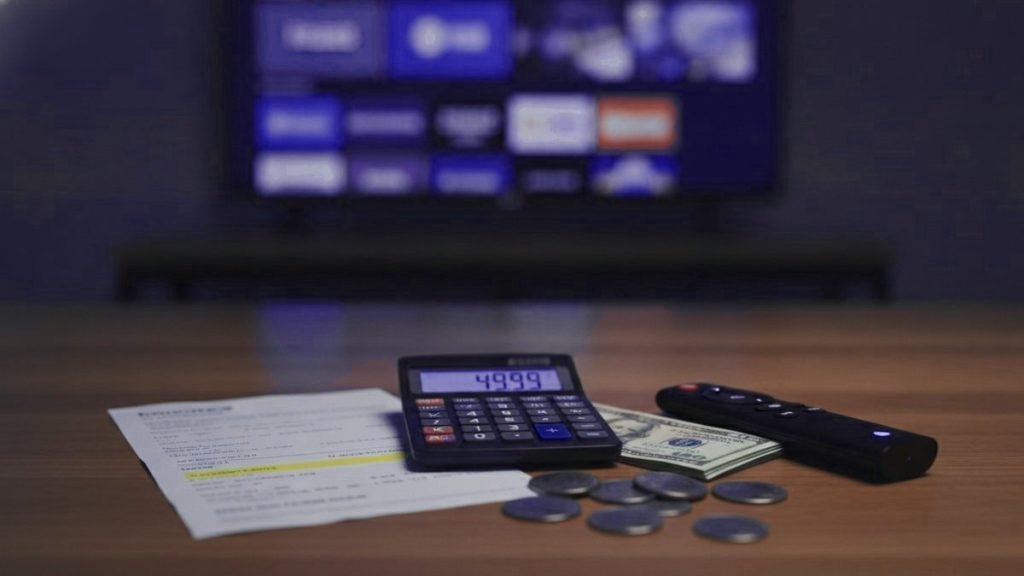
An IPTV subscription with Euroskara costs between €15 for one month on a single screen and €239 for twelve months on five screens, with no contract, no equipment rental and nothing that renews by itself. That range is correct but not very helpful. What a household actually pays depends on how many televisions need to play at the same time and how long you commit for, and whether the result is good value depends on what you are paying for television today. This page works through it in euros, per screen, with examples from different corners of Europe.
Start with what you watch on at the same time
Before looking at any price, count simultaneous screens, not devices. A home may own a smart TV, two phones, a tablet and a laptop, but if only the living-room TV and one bedroom TV are ever on together, that home needs two screens. Our plans limit how many streams play at once; you can install the app on more devices than that.
A quick way to count: think of the busiest moment of a typical week, perhaps Sunday evening or a big match night, and count how many screens are showing live television or on-demand content from the subscription at that moment. That number is your tier. If it is sometimes one higher, ask yourself whether that happens often enough to pay for.
The price sheet, in euros
| Term | 1 screen | 2 screens | 3 screens | 5 screens |
|---|---|---|---|---|
| 1 month | €15 | €25 | €35 | €49 |
| 3 months | €29 | €49 | €65 | €99 |
| 6 months | €45 | €75 | €99 | €149 |
| 12 months | €69 | €119 | €159 | €239 |
Every plan includes the same service: 25,000+ live channels, 120,000+ films and series on demand, the programme guide, catch-up where supported, 4K feeds where they exist, and 24/7 support on WhatsApp. The only variables are the term and the number of screens. The live table is always on the pricing page, which takes precedence if anything here is ever out of date.
The same prices, divided by screens and by months
The sheet above hides the two discounts that matter: each additional screen costs less than the first, and longer terms cost less per month. Divided out, the monthly cost of each screen looks like this:
| Term | 1 screen | 2 screens | 3 screens | 5 screens |
|---|---|---|---|---|
| 1 month | €15.00 | €12.50 | €11.67 | €9.80 |
| 3 months | €9.67 | €8.17 | €7.22 | €6.60 |
| 6 months | €7.50 | €6.25 | €5.50 | €4.97 |
| 12 months | €5.75 | €4.96 | €4.42 | €3.98 |
Figures are per screen, per month, rounded to the nearest cent. The spread is wide: a single month on one screen costs almost four times as much per screen-month as a year on five. That is the reason to think about term length carefully, but not the reason to jump straight to the longest one, as the next sections explain.
Four households, priced out
These are illustrative examples, not customers.
A single viewer in Brussels
One person, one television, follows Belgian and French news and the Pro League at weekends. After a trial and a first month at €15 to be sure, a twelve-month plan at €69 brings the cost to €5.75 a month. Nothing else is needed: the smart TV already runs a player app.
A couple in Manchester paying from a sterling account
Two televisions that are sometimes on together, mostly for British channels and Premier League football. Six months on two screens is €75, or €12.50 a month for both. Because the card is in pounds, the bank converts the payment and may charge a foreign transaction fee on top, so the figure on the statement will not be exactly €75 translated at the day’s rate. Checking the card’s terms first, or using a card without foreign fees, avoids a small surprise.
A family of four in Munich
Three screens at the busiest time: the living room, a teenager’s room and a tablet in the kitchen. The parents follow the Bundesliga and English football; the children watch German and English programmes. Twelve months on three screens is €159, which is €13.25 a month for the household, or €4.42 per screen. A fourth screen is used occasionally, not often enough to justify the five-screen tier.
A British household with a holiday home in the Algarve
People in this position sometimes assume they need two subscriptions, one for each property. They do not, because the subscription is tied to simultaneous streams rather than to an address: a two-screen plan used in Surrey in winter and in Portugal in summer is still a two-screen plan. The two properties are one household using its screens in different places, not two households sharing an account. What matters at the holiday home is the connection. If it is a mobile router with a data cap, HD streams will use it up quickly, and choosing the lower-quality version of each channel stretches it further.
Costs that sit outside the subscription
A device, usually not
Most European homes already have something that runs a player: a Samsung or LG smart TV, a Google TV set from Sony, Philips or TCL, a Fire TV Stick, an Apple TV, a phone or a laptop. If you do buy something, a streaming stick is the usual choice. Our guide to devices for European living rooms goes through the options.
A player app, often free
Several players are free. Some charge: TiViMate’s premium features are a paid subscription, and apps such as Smart IPTV and IBO Player ask for a one-off activation fee per television after a trial period. Those payments go to the app developers, not to us, and prices vary by app and sometimes by country. Our guide to players by TV brand covers which you can use without paying.
Broadband, rarely
Most European connections carry HD television comfortably, and full fibre, now common in Spain, Portugal, France and the Nordic countries, carries several 4K streams at once. Upgrading your broadband package is seldom necessary. If the picture struggles, the cheaper fixes come first: an Ethernet cable or powerline adapter to the television device, moving the router, or choosing the HD version of a channel instead of 4K. Only when a line tests slow at the busiest time of evening, on a wired device, is a faster package worth pricing up. A rural ADSL line that manages one HD stream is a reason to buy a single screen, not to pay for three.
Currency conversion
If your account is not in euros, count the conversion fee as part of the price. Across a year’s subscription it is a small amount, but it is real.
A VPN, not required
You do not need a VPN to use Euroskara. Some people use one for other reasons, and it adds its own subscription cost if you do.
Licences and broadcasting fees
These are not IPTV costs, but they are often forgotten in comparisons. In the UK, watching or recording television as it is broadcast requires a TV Licence, whatever the service or device. Germany charges a broadcasting contribution per household regardless of which devices it owns. Ireland and several other countries have their own arrangements. None of these changes if you add or remove an IPTV subscription, so leave them out of any comparison, but do not assume IPTV removes them.
Against a European pay-TV bundle, in general terms
Comparing prices with a specific operator is unreliable, because offers change constantly and vary by country, region and promotion. What can be compared is how the two are structured.
| Typical pay-TV bundle | Euroskara | |
|---|---|---|
| Contract | Often 12 to 24 months, with charges for leaving early | From one month, nothing renews automatically |
| Equipment | A decoder supplied by the operator, sometimes with rental or set-up fees | Your own device and a player app |
| Sport | Usually an extra tier, and one country’s rights holders only | Included in every plan |
| Other countries’ channels | Limited, often sold as add-on packs | Included in every plan |
| Price changes during the term | Depends on the contract and on national consumer rules | The price paid is fixed for the term |
| Rights | Licensed for your country | Independent provider; see our legal guide |
The last row matters and should not be skipped. A licensed pay-TV bundle is priced to cover the rights to what it shows in your country. Our guide to IPTV and the law in the UK and EU explains what that means for you. On cost alone, the structural difference is that a bundle charges for one country’s line-up plus extras, over a long contract, while an IPTV subscription charges for screens and time.
A useful exercise is to take your last broadband-and-TV bill, find the part that is television (the TV package, sports tier, box rental and any add-ons), and compare that amount, not the whole bill, with the relevant row of the per-screen table above. Keep in mind that broadband stays regardless.
When a longer term makes sense, and when it does not
A twelve-month plan is the cheapest way to pay, but only once you know the service works for your household. The sequence we suggest is:
- Take the free trial on a busy evening. It costs nothing and needs no card. See the trial page.
- If it worked, consider a short first term, one or three months, especially if your household watches a lot of sport and you want to see it through several match weeks.
- Move to six or twelve months once you are confident. The saving over repeated monthly plans is large.
Our refund policy gives 7 days from activation on a first purchase if the service does not work on your device and support cannot fix it. It is a protection against a technical failure, not a trial extension, which is another reason to use the free trial properly before buying a long term.
Prices that should worry you
Very low prices are not automatically a bargain. Running servers that hold up during a Champions League evening costs money every month, and a price far below what that could possibly cost usually means overloaded servers, a service that disappears mid-term, or both. Be especially wary of:
- “Lifetime” plans, which ask you to prepay for a service indefinitely;
- offers with no published price, where you are quoted privately;
- long terms at an introductory price from a seller with no website, no terms and no refund policy.
The cheapest price per month is only cheap if the service is still there, and still working, in month eleven.
Questions on this topic
How much does IPTV cost per month in euros?
With Euroskara, one screen costs €15 for a single month, €29 for three months, €45 for six months or €69 for twelve months, which works out at €5.75 a month. Plans for two, three and five screens are listed on the pricing page. There is no contract and nothing renews automatically.
What is the cheapest price per screen?
Twelve months on five screens at €239, which is about €3.98 per screen per month. It only makes sense if five screens genuinely play at the same time in your household; otherwise a smaller tier costs less overall.
Do I need to buy a box or pay for an app?
Usually not. Most smart TVs, streaming sticks, phones and computers already run a free player. Some apps charge for premium features or a one-off activation per television; those fees go to the app developer, not to Euroskara.
Is IPTV cheaper than a European pay-TV bundle?
Structurally it is priced differently: an IPTV plan charges for screens and time, while bundles typically charge for one country's line-up, a sports tier and equipment over a 12 to 24 month contract. Compare the TV part of your bill with our per-screen table, and read our legal guide, because licensed bundles also pay for broadcast rights.
Will I pay extra if my bank account is not in euros?
Your bank converts the payment and may add a foreign transaction fee. It is a small amount on a subscription, but check your card terms or use a card without foreign fees if you want to avoid it.
Should my first purchase be a twelve-month plan?
Not straight away. Take the free 24-hour trial on a busy evening first, then consider a one- or three-month plan to see the service through several match weeks. Once you are confident, six or twelve months costs far less per month.
Every European country group, 25,000+ channels in all
Priced in euros and ordered in one WhatsApp chat, usually live in under 15 minutes. You have 7 days to ask for a refund.
Read next
Streaming Boxes for European Living Rooms, Judged for IPTV
Six devices common in European homes, from the Fire TV Stick 4K Max to MAG boxes, judged on 50 Hz output, wired…
4 September 2026Which IPTV Player Will Run on the Television You Bought in Europe
Which IPTV players you can install depends on your TV's operating system and your app store's country. A platform-by-platform guide for Samsung,…
31 August 2026IPTV and the Law in Britain, Ireland and the European Union
The general legal position on IPTV in the EU, the UK and Ireland: why licensing decides, what the Filmspeler judgment said, how…